 Add to Chrome
 Add to Firefox
 Add to Edge
Hyperspectral Anomaly Detection
Papers and Code
Beyond Reconstruction: Reconstruction-to-Vector Diffusion for Hyperspectral Anomaly Detection
Apr 14, 2026
While Hyperspectral Anomaly Detection (HAD) excels at identifying sparse targets in complex scenes, existing models remain trapped in a scalar "reconstruction-as-endpoint" paradigm. This reliance on ambiguous scalar residuals consistently triggers sub-pixel anomaly vanishing during spatial downsampling, alongside severe confirmation bias when unpurified anomalies corrupt training weights. In this paper, we propose Reconstruction-to-Vector Diffusion (R2VD), which fundamentally redefines reconstruction as a manifold purification origin to establish a novel residual-guided generative dynamics paradigm. Our framework introduces a four-stage pipeline: (1) a Physical Prior Extraction (PPE) stage that mitigates early confirmation bias via dual-stream statistical guidance; (2) a Guided Manifold Purification (GMP) stage utilizing an OmniContext Autoencoder (OCA) to extract purified residual maps while preserving fragile sub-pixel topologies; (3) a Residual Score Modeling (RSM) stage where a Diffusion Transformer (DiT), guarded by a Physical Spectral Firewall (PSF), effectively isolates cross-spectral leakage; and (4) a Vector Dynamics Inference (VDI) stage that robustly decouples targets from backgrounds by evaluating high-dimensional vector interference patterns instead of conventional scalar errors. Comprehensive evaluations on eight datasets confirm that R2VD establishes a new state-of-the-art, delivering exceptional target detectability and background suppression. The code is available at https://github.com/Bondojijun/R2VD.

Hyperspectral Trajectory Image for Multi-Month Trajectory Anomaly Detection
Mar 26, 2026Trajectory anomaly detection underpins applications from fraud detection to urban mobility analysis. Dense GPS methods preserve fine-grained evidence such as abnormal speeds and short-duration events, but their quadratic cost makes multi-month analysis intractable; consequently, no existing approach detects anomalies over multi-month dense GPS trajectories. The field instead relies on scalable sparse stay-point methods that discard this evidence, forcing separate architectures for each regime and preventing knowledge transfer. We argue this bottleneck is unnecessary: human trajectories, dense or sparse, share a natural two-dimensional cyclic structure along within-day and across-day axes. We therefore propose TITAnD (Trajectory Image Transformer for Anomaly Detection), which reformulates trajectory anomaly detection as a vision problem by representing trajectories as a Hyperspectral Trajectory Image (HTI): a day x time-of-day grid whose channels encode spatial, semantic, temporal, and kinematic information from either modality, unifying both under a single representation. Under this formulation, agent-level detection reduces to image classification and temporal localization to semantic segmentation. To model this representation, we introduce the Cyclic Factorized Transformer (CFT), which factorizes attention along the two temporal axes, encoding the cyclic inductive bias of human routines, while reducing attention cost by orders of magnitude and enabling dense multi-month anomaly detection for the first time. Empirically, TITAnD achieves the best AUC-PR across sparse and dense benchmarks, surpassing vision models like UNet while being 11-75x faster than the Transformer with comparable memory, demonstrating that vision reformulation and structure-aware modeling are jointly essential. Code will be made public soon.
Robust Principal Component Completion
Mar 26, 2026Robust principal component analysis (RPCA) seeks a low-rank component and a sparse component from their summation. Yet, in many applications of interest, the sparse foreground actually replaces, or occludes, elements from the low-rank background. To address this mismatch, a new framework is proposed in which the sparse component is identified indirectly through determining its support. This approach, called robust principal component completion (RPCC), is solved via variational Bayesian inference applied to a fully probabilistic Bayesian sparse tensor factorization. Convergence to a hard classifier for the support is shown, thereby eliminating the post-hoc thresholding required of most prior RPCA-driven approaches. Experimental results reveal that the proposed approach delivers near-optimal estimates on synthetic data as well as robust foreground-extraction and anomaly-detection performance on real color video and hyperspectral datasets, respectively. Source implementation and Appendices are available at https://github.com/WongYinJ/BCP-RPCC.
A real-time UAS hyperspectral anomaly detection system
Feb 13, 2026Detecting anomalies in hyperspectral image data, i.e. regions which are spectrally distinct from the image background, is a common task in hyperspectral imaging. Such regions may represent interesting objects to human operators, but obtaining results often requires post-processing of captured data, delaying insight. To address this limitation, we apply an anomaly detection algorithm to a visible and near-infrared (VNIR) push-broom hyperspectral image sensor in real time onboard a small uncrewed aerial system (UAS), exploring how UAS limitations affect the algorithm. As the generated anomaly information is much more concise than the raw hyperspectral data, it can feasibly be transmitted wirelessly. To detection, we couple an innovative and fast georectification algorithm that enables anomalous areas to be interactively investigated and characterized immediately by a human operator receiving the anomaly data at a ground station. Using these elements, we demonstrate a novel and complete end-to-end solution from data capture and preparation, through anomaly detection and transmission, to ground station display and interaction, all in real time and with relatively low cost components.
DMS2F-HAD: A Dual-branch Mamba-based Spatial-Spectral Fusion Network for Hyperspectral Anomaly Detection
Feb 04, 2026Hyperspectral anomaly detection (HAD) aims to identify rare and irregular targets in high-dimensional hyperspectral images (HSIs), which are often noisy and unlabelled data. Existing deep learning methods either fail to capture long-range spectral dependencies (e.g., convolutional neural networks) or suffer from high computational cost (e.g., Transformers). To address these challenges, we propose DMS2F-HAD, a novel dual-branch Mamba-based model. Our architecture utilizes Mamba's linear-time modeling to efficiently learn distinct spatial and spectral features in specialized branches, which are then integrated by a dynamic gated fusion mechanism to enhance anomaly localization. Across fourteen benchmark HSI datasets, our proposed DMS2F-HAD not only achieves a state-of-the-art average AUC of 98.78%, but also demonstrates superior efficiency with an inference speed 4.6 times faster than comparable deep learning methods. The results highlight DMS2FHAD's strong generalization and scalability, positioning it as a strong candidate for practical HAD applications.
Utilizing the Score of Data Distribution for Hyperspectral Anomaly Detection
Jan 18, 2026Hyperspectral images (HSIs) are a type of image that contains abundant spectral information. As a type of real-world data, the high-dimensional spectra in hyperspectral images are actually determined by only a few factors, such as chemical composition and illumination. Thus, spectra in hyperspectral images are highly likely to satisfy the manifold hypothesis. Based on the hyperspectral manifold hypothesis, we propose a novel hyperspectral anomaly detection method (named ScoreAD) that leverages the time-dependent gradient field of the data distribution (i.e., the score), as learned by a score-based generative model (SGM). Our method first trains the SGM on the entire set of spectra from the hyperspectral image. At test time, each spectrum is passed through a perturbation kernel, and the resulting perturbed spectrum is fed into the trained SGM to obtain the estimated score. The manifold hypothesis of HSIs posits that background spectra reside on one or more low-dimensional manifolds. Conversely, anomalous spectra, owing to their unique spectral signatures, are considered outliers that do not conform to the background manifold. Based on this fundamental discrepancy in their manifold distributions, we leverage a generative SGM to achieve hyperspectral anomaly detection. Experiments on the four hyperspectral datasets demonstrate the effectiveness of the proposed method. The code is available at https://github.com/jiahuisheng/ScoreAD.
Turbo-GoDec: Exploiting the Cluster Sparsity Prior for Hyperspectral Anomaly Detection
Jan 18, 2026As a key task in hyperspectral image processing, hyperspectral anomaly detection has garnered significant attention and undergone extensive research. Existing methods primarily relt on two prior assumption: low-rank background and sparse anomaly, along with additional spatial assumptions of the background. However, most methods only utilize the sparsity prior assumption for anomalies and rarely expand on this hypothesis. From observations of hyperspectral images, we find that anomalous pixels exhibit certain spatial distribution characteristics: they often manifest as small, clustered groups in space, which we refer to as cluster sparsity of anomalies. Then, we combined the cluster sparsity prior with the classical GoDec algorithm, incorporating the cluster sparsity prior into the S-step of GoDec. This resulted in a new hyperspectral anomaly detection method, which we called Turbo-GoDec. In this approach, we modeled the cluster sparsity prior of anomalies using a Markov random field and computed the marginal probabilities of anomalies through message passing on a factor graph. Locations with high anomalous probabilities were treated as the sparse component in the Turbo-GoDec. Experiments are conducted on three real hyperspectral image (HSI) datasets which demonstrate the superior performance of the proposed Turbo-GoDec method in detecting small-size anomalies comparing with the vanilla GoDec (LSMAD) and state-of-the-art anomaly detection methods. The code is available at https://github.com/jiahuisheng/Turbo-GoDec.
Mitigating Long-Tailed Anomaly Score Distributions with Importance-Weighted Loss
Jan 05, 2026Anomaly detection is crucial in industrial applications for identifying rare and unseen patterns to ensure system reliability. Traditional models, trained on a single class of normal data, struggle with real-world distributions where normal data exhibit diverse patterns, leading to class imbalance and long-tailed anomaly score distributions (LTD). This imbalance skews model training and degrades detection performance, especially for minority instances. To address this issue, we propose a novel importance-weighted loss designed specifically for anomaly detection. Compared to the previous method for LTD in classification, our method does not require prior knowledge of normal data classes. Instead, we introduce a weighted loss function that incorporates importance sampling to align the distribution of anomaly scores with a target Gaussian, ensuring a balanced representation of normal data. Extensive experiments on three benchmark image datasets and three real-world hyperspectral imaging datasets demonstrate the robustness of our approach in mitigating LTD-induced bias. Our method improves anomaly detection performance by 0.043, highlighting its effectiveness in real-world applications.
* 8 pages, Published as a conference paper at IJCNN 2025
Hyperspectral Anomaly Detection Fused Unified Nonconvex Tensor Ring Factors Regularization
May 23, 2025In recent years, tensor decomposition-based approaches for hyperspectral anomaly detection (HAD) have gained significant attention in the field of remote sensing. However, existing methods often fail to fully leverage both the global correlations and local smoothness of the background components in hyperspectral images (HSIs), which exist in both the spectral and spatial domains. This limitation results in suboptimal detection performance. To mitigate this critical issue, we put forward a novel HAD method named HAD-EUNTRFR, which incorporates an enhanced unified nonconvex tensor ring (TR) factors regularization. In the HAD-EUNTRFR framework, the raw HSIs are first decomposed into background and anomaly components. The TR decomposition is then employed to capture the spatial-spectral correlations within the background component. Additionally, we introduce a unified and efficient nonconvex regularizer, induced by tensor singular value decomposition (TSVD), to simultaneously encode the low-rankness and sparsity of the 3-D gradient TR factors into a unique concise form. The above characterization scheme enables the interpretable gradient TR factors to inherit the low-rankness and smoothness of the original background. To further enhance anomaly detection, we design a generalized nonconvex regularization term to exploit the group sparsity of the anomaly component. To solve the resulting doubly nonconvex model, we develop a highly efficient optimization algorithm based on the alternating direction method of multipliers (ADMM) framework. Experimental results on several benchmark datasets demonstrate that our proposed method outperforms existing state-of-the-art (SOTA) approaches in terms of detection accuracy.
CL-BioGAN: Biologically-Inspired Cross-Domain Continual Learning for Hyperspectral Anomaly Detection
May 17, 2025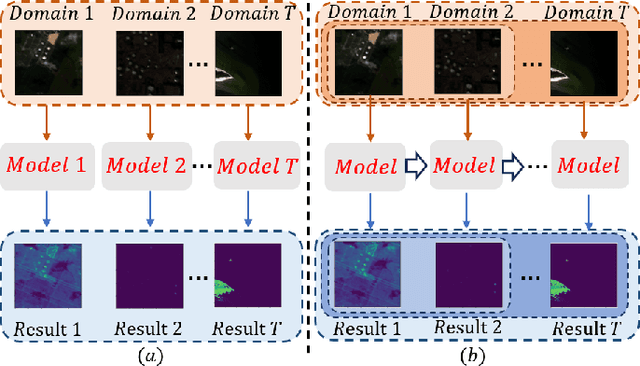
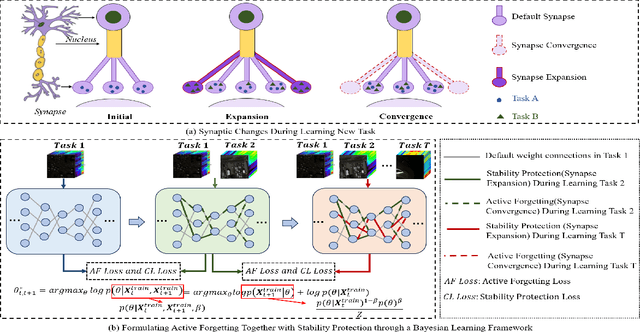
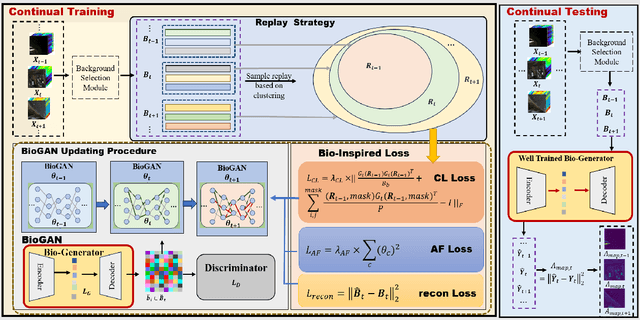
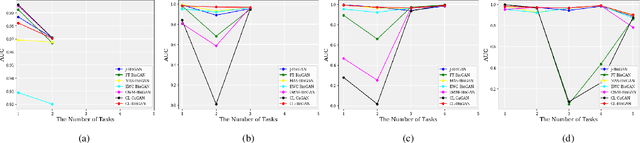
Memory stability and learning flexibility in continual learning (CL) is a core challenge for cross-scene Hyperspectral Anomaly Detection (HAD) task. Biological neural networks can actively forget history knowledge that conflicts with the learning of new experiences by regulating learning-triggered synaptic expansion and synaptic convergence. Inspired by this phenomenon, we propose a novel Biologically-Inspired Continual Learning Generative Adversarial Network (CL-BioGAN) for augmenting continuous distribution fitting ability for cross-domain HAD task, where Continual Learning Bio-inspired Loss (CL-Bio Loss) and self-attention Generative Adversarial Network (BioGAN) are incorporated to realize forgetting history knowledge as well as involving replay strategy in the proposed BioGAN. Specifically, a novel Bio-Inspired Loss composed with an Active Forgetting Loss (AF Loss) and a CL loss is designed to realize parameters releasing and enhancing between new task and history tasks from a Bayesian perspective. Meanwhile, BioGAN loss with L2-Norm enhances self-attention (SA) to further balance the stability and flexibility for better fitting background distribution for open scenario HAD (OHAD) tasks. Experiment results underscore that the proposed CL-BioGAN can achieve more robust and satisfying accuracy for cross-domain HAD with fewer parameters and computation cost. This dual contribution not only elevates CL performance but also offers new insights into neural adaptation mechanisms in OHAD task.